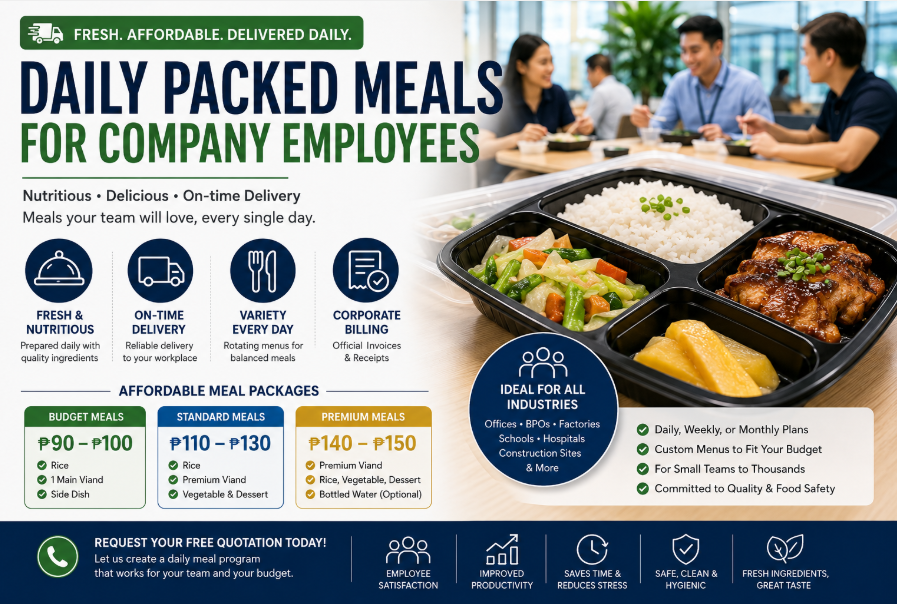
Daily packed meal delivery can provide companies with a practical way to serve employees without operating a full in-house kitchen. Meals can be prepared according to an agreed headcount, packed individually, and delivered to the workplace according to scheduled lunch, dinner, or shift meal times.
For offices, factories, BPO operations, warehouses, schools, and other workplaces, however, successful daily meal service requires more than simply ordering food each morning. Headcount cutoffs, menu rotation, delivery schedules, receiving procedures, dietary requirements, and employee distribution all need to be coordinated.
Here is how a typical daily packed meal program for company employees can be organized.
1. Establish the Daily Meal Requirement
The first step is determining how the company intends to use the meal service.
Some organizations provide lunch to employees every working day, while others require meals for specific departments, shifts, overtime schedules, training programs, or selected days of the week.
Before arranging daily delivery, determine:
- Approximate number of meals required per day
- Days when meals are needed
- Lunch, dinner, or other meal periods
- Departments or employees covered by the program
- Number of workplace locations
- Expected duration of the meal arrangement
These details provide the basic structure for the daily meal service.
2. Set a Daily Headcount Cutoff
Employee attendance can change from one day to another. Employees may be absent, working remotely, assigned off-site, on leave, or working a different shift.
For this reason, companies using recurring packed meal delivery should establish a clear cutoff for submitting the final meal quantity.
For larger organizations, departments can submit their requirements to one internal coordinator before the final total is sent to the caterer.
3. Create a Menu Rotation
Menu variety becomes important when employees receive packed meals several times a week.
Instead of choosing meals independently every day, companies and their food provider can prepare a rotating menu covering a week or several weeks.
A typical packed meal may combine:
- Rice or another staple
- Meat, poultry, fish, or another main dish
- Vegetables or a side dish
- Dessert or fruit, depending on the arrangement
- Beverage, when included
The objective of menu rotation is to provide enough variety while keeping daily meal production organized and predictable.
Companies that want to compare available meal formats and package options can view Executive Gourmet’s packed meals catering packages.
4. Coordinate the Delivery Time With Employee Breaks
Delivery timing is one of the most important parts of a recurring employee meal program.
Meals should ideally arrive with enough time for receiving and distribution before the scheduled employee break.
If lunch begins at noon, for example, the delivery schedule should account for building entry, unloading, checking the order, and moving the meals to the designated distribution area.
The objective is to have the meals ready when employees begin their break rather than having employees wait for the delivery.
5. Plan for Multiple Employee Shifts
Factories, BPO companies, warehouses, hospitals, and other organizations may operate more than one shift.
In these situations, one daily delivery may not be sufficient.
| Work Arrangement | Possible Meal Coordination |
|---|---|
| Regular office schedule | Scheduled lunch delivery |
| Morning and evening shifts | Separate delivery windows |
| 24-hour operations | Multiple meal periods based on shift schedules |
| Overtime operations | Additional meals based on confirmed overtime headcount |
Each delivery window should have its own quantity, receiving instructions, and designated contact person when necessary.
6. Organize Meal Receiving and Distribution
The company should identify where delivered meals will be received and how they will reach employees.
Depending on the workplace, meals may be delivered to a pantry, cafeteria, receiving area, office floor, warehouse, or another designated location.
Before service begins, clarify:
- Exact delivery entrance
- Building access requirements
- Receiving location
- Name and contact number of the receiver
- Where meals will be temporarily stored
- How meals will be distributed to employees
Having a consistent receiving process can make recurring deliveries easier for both the company and the food provider.
7. Use Labels When Meals Need to Be Identified
Meal identification can become useful when different departments, shifts, locations, or dietary requirements are involved.
Depending on the arrangement, labels may help identify:
- Department or team
- Delivery location
- Shift
- Meal type
- Special meal request
A clear labeling system can reduce confusion when many packed meals arrive at the same time.
8. Establish a Process for Dietary Requirements
Some employees may require alternative meals because of allergies, dietary restrictions, religious requirements, or other considerations.
Companies should collect these requirements in advance rather than communicating them separately with every daily order.
Special meals should also be clearly identifiable during distribution so they reach the correct employees.
A Simple Internal Process
- Collect employee dietary requirements.
- Maintain an updated internal list.
- Include required special meals in the daily headcount.
- Communicate changes before the agreed cutoff.
- Identify special meals during distribution.
9. Plan for Changes in Daily Attendance
One of the main differences between a one-time packed meal order and a recurring employee meal program is that the quantity may change regularly.
A company might require 150 meals on Monday, 140 on Tuesday, and a different number later in the week because of employee schedules or attendance.
A defined process for communicating these changes helps both sides prepare accurately.
Companies should also determine how late additions, cancellations, and significant headcount changes will be handled.
10. Coordinate Meals for Overtime and Special Workdays
Employee meal requirements may extend beyond the regular Monday-to-Friday schedule.
Organizations may occasionally need additional meals for:
- Overtime work
- Weekend operations
- Inventory activities
- Company training
- Special projects
- Peak production periods
- Holiday operations
These requirements should ideally be communicated separately from the regular daily headcount so the additional meals can be properly scheduled.
11. Assign a Company Meal Coordinator
Recurring meal programs are easier to manage when the company has one primary contact person.
This person does not necessarily need to distribute every meal. Instead, the coordinator acts as the main communication point between the company and the food provider.
The coordinator may handle:
- Daily headcount confirmation
- Schedule changes
- Special meal requests
- Delivery instructions
- Feedback from employees
- Coordination with departments or shifts
12. Keep Ordering Procedures Consistent
A recurring meal arrangement becomes easier to administer when the same ordering procedure is followed every day.
Instead of different employees sending separate orders through different channels, establish a standard process for submitting quantities and changes.
For example, department representatives can submit their counts internally, after which one coordinator sends the consolidated requirement to the caterer.
13. Monitor the Meal Program
Daily meal delivery should be reviewed periodically rather than operating indefinitely without feedback.
Companies can monitor practical issues such as:
- Delivery punctuality
- Order accuracy
- Menu variety
- Employee feedback
- Packaging
- Special meal accuracy
- Quantity adjustments
- Receiving and distribution efficiency
This allows small operational problems to be identified and corrected before they become recurring issues.
Daily Packed Meals vs. One-Time Packed Meal Orders
A one-time packed meal order is usually organized around a single event, meeting, seminar, or activity.
Daily employee meal delivery is different because it involves an ongoing operating process.
| One-Time Order | Recurring Employee Meals |
|---|---|
| Single confirmed headcount | Headcount may change regularly |
| One menu requirement | Menu rotation becomes important |
| One delivery schedule | Recurring delivery windows |
| Usually one receiving arrangement | May involve departments or multiple shifts |
| Short-term coordination | Ongoing communication and monitoring |
When Daily Packed Meal Delivery Can Be Useful
Recurring packed meal delivery may be practical for companies that need regular employee meals but do not require or cannot operate a full on-site kitchen.
It may also be useful when:
- Employees have scheduled meal breaks
- Nearby food choices are limited
- The company provides subsidized or company-paid meals
- Operations involve several shifts
- Meal requirements change according to attendance
- The workplace needs meals delivered to a specific location
The appropriate arrangement depends on the number of employees, delivery location, schedule, menu requirements, and frequency of service.
Daily Employee Meal Delivery Checklist
Information to Prepare
- Estimated meals per day
- Days of the week requiring service
- Employee meal-break times
- Number of shifts
- Delivery windows
- Exact delivery location
- Receiving instructions
- Daily headcount cutoff
- Menu rotation requirements
- Dietary requirements
- Department or shift labeling requirements
- Primary company coordinator
Building a Reliable Daily Meal Routine
The key to daily employee packed meal delivery is consistency.
A clear headcount process, predictable delivery schedule, rotating menu, designated receiving area, and single communication channel can make recurring meal service easier to manage.
Once the process is established, companies can adjust quantities and menus while keeping the basic ordering and delivery workflow consistent.
Looking for Packed Meals for Your Employees?
Executive Gourmet provides packed meal catering for companies, offices, workplaces, corporate events, and other group requirements in Metro Manila.
View available meal formats and catering options to find an arrangement suitable for your headcount, schedule, and delivery requirements.
View Packed Meals Catering PackagesFrequently Asked Questions
“`
“`
“`
“`
“`
Need packed meals for your workplace? Visit our packed meals catering packages in Metro Manila for available options and catering arrangements.