Employee Meal Program Implementation Guide
A step-by-step guide for planning, launching, managing, and improving an employee meal program for your company.
An employee meal program can improve workplace convenience, support employee well-being, reduce time spent leaving the office for food, and help companies provide a more consistent employee experience.
However, a successful program requires more than selecting a menu and arranging delivery. Companies must define the program’s purpose, budget, eligibility, ordering process, menu standards, delivery schedule, food-safety controls, employee communication, and performance measures.
This employee meal program implementation guide provides a practical framework for human resources, administration, procurement, finance, operations, and workplace teams.
Why Companies Implement Employee Meal Programs
Employee Convenience
Employees can access meals at the workplace without spending additional time traveling, ordering, or waiting during breaks.
Better Productivity
Reliable workplace meals can reduce extended lunch breaks and support more predictable work schedules.
Employee Engagement
A well-managed meal benefit can contribute to employee satisfaction, workplace culture, and retention efforts.
Operational Control
Centralized meal ordering makes costs, deliveries, menu standards, and supplier performance easier to monitor.
How to Implement an Employee Meal Program
Follow these steps to move from initial planning to a stable, measurable workplace meal program.
Define the Business Objective
Identify why the company is introducing the meal program and what result it expects.
- Improve employee convenience
- Support return-to-office programs
- Provide meals for shifts or overtime
- Reduce long lunch breaks
- Strengthen employee benefits
Identify Employee Needs
Gather information about employee schedules, food preferences, dietary requirements, and expected participation.
- Number of eligible employees
- Office and shift schedules
- Preferred meal times
- Dietary restrictions
- Expected daily participation
Establish the Budget
Set the maximum company contribution and define whether employees will pay part of the meal cost.
- Budget per meal
- Daily or monthly spending limit
- Delivery and service charges
- Administrative costs
- Contingency allowance
Choose the Program Model
Select the arrangement that best matches company objectives, employee schedules, facilities, and administrative capacity.
- Fully subsidized meals
- Partially subsidized meals
- Employee-paid group ordering
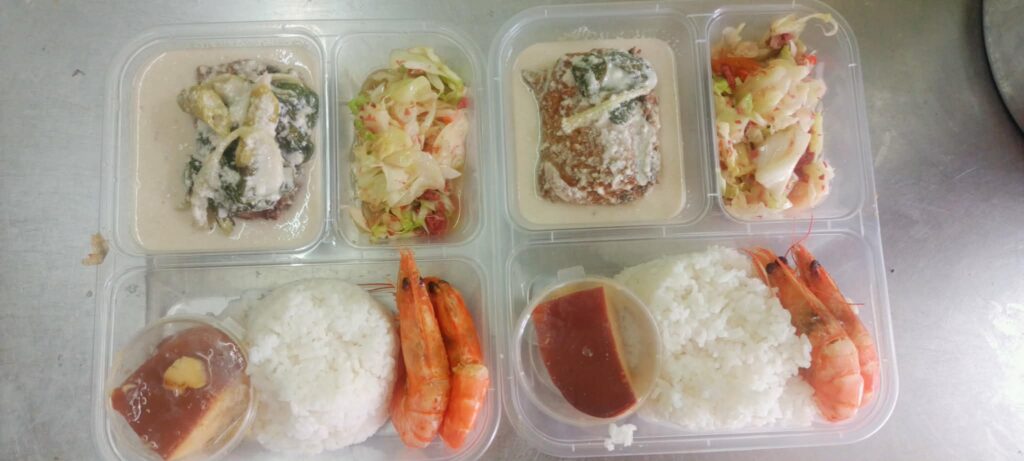
- Packed meal delivery
- Buffet or managed cafeteria service
Select a Catering Vendor
Compare qualified suppliers using documented evaluation criteria rather than relying only on price.
- Food quality and menu variety
- Food-safety controls
- Delivery reliability
- Production capacity
- Pricing and service support
Design the Menu Cycle
Create a menu rotation that balances variety, employee preferences, nutrition, cost, and operational practicality.
- Main dish rotation
- Rice or alternative carbohydrates
- Vegetable options
- Special dietary meals
- Menu repetition limits
Employee Meal Program Models
The right model depends on budget, workplace size, employee schedules, and company objectives.
| Program Model | How It Works | Best For | Main Consideration |
|---|---|---|---|
| Fully Subsidized | The company pays the full cost of eligible meals. | Employee benefits, shifts, overtime, and return-to-office programs | Requires stronger budget controls. |
| Partially Subsidized | The company pays a fixed amount while employees cover the remaining cost. | Companies balancing employee support and cost control | Employee payment collection must be organized. |
| Employee-Paid Group Ordering | Employees pay for meals, while the company coordinates ordering and delivery. | Offices seeking convenience without a large subsidy | Participation may vary daily. |
| Packed Meal Delivery | Individually packed meals are delivered according to a fixed schedule. | Offices, training sessions, shifts, and multiple departments | Accurate meal counts and labeling are essential. |
| Buffet Service | Meals are served from a managed buffet setup. | Meetings, events, executive dining, and group lunches | Requires space, equipment, and service management. |
| Pantry-Catering Hybrid | Pantry snacks and beverages are combined with scheduled catered meals. | Companies seeking flexible daily food support | Requires separate inventory and supplier coordination. |
How to Build an Employee Meal Program Budget
Meal program costs should be calculated using expected participation, not only the total employee headcount. Companies should also account for delivery, service, packaging, special meals, administrative work, and possible food-price adjustments.
| Budget Item | Questions to Consider |
|---|---|
| Meal cost | What is the agreed price per meal or package? |
| Participation | How many employees are expected to order each day? |
| Company subsidy | Will the company pay the full cost or a fixed share? |
| Delivery | Are delivery fees included or charged separately? |
| Special meals | Do dietary or premium options have different prices? |
| Administrative cost | Who will manage ordering, reconciliation, and reporting? |
| Contingency | Is there an allowance for overtime, additional attendees, or emergency orders? |
Basic Monthly Cost Formula
Expected participants per day
× Company contribution per meal
× Number of service days
+ Delivery, service, and administrative costs
Use actual participation data after the pilot period to improve budget accuracy.
Selecting the Catering Partner
The catering vendor should be evaluated based on its ability to deliver the complete service consistently, not only on a successful food tasting.
- Verify business and food-safety documentation.
- Review relevant corporate catering experience.
- Confirm daily production and delivery capacity.
- Conduct a structured tasting.
- Review pricing, exclusions, and payment terms.
- Test the supplier through a pilot program.
Vendor Questions to Ask
- What is your maximum daily production capacity?
- How do you manage late changes and additional orders?
- What controls are used during preparation and delivery?
- How are special dietary meals identified?
- What happens if a vehicle or production area becomes unavailable?
- How quickly are complaints investigated and resolved?
Build a Practical Employee Meal Menu
Variety
Rotate proteins, vegetables, sauces, and cooking styles to reduce menu fatigue.
Portion Consistency
Define standard portions so employees receive consistent value across meal days.
Dietary Options
Establish a process for vegetarian, allergen-aware, low-sodium, or other approved meal requests.
Operational Suitability
Select meals that travel, hold, package, and serve well under actual workplace conditions.
Design the Ordering Process
The ordering system should be simple enough for employees to use and structured enough for the company and caterer to control meal quantities accurately.
- Define who is eligible to order.
- Set daily ordering and cancellation deadlines.
- Choose between individual ordering and centralized ordering.
- Establish approval rules for subsidized meals.
- Create a process for visitors and overtime meals.
- Reconcile orders against actual deliveries and invoices.
Plan Delivery and Receiving
The company should define where, when, and how meals will be delivered, inspected, accepted, stored, and distributed.
- Confirm delivery entrance and contact person.
- Set a required delivery time window.
- Assign a receiving employee.
- Check quantity, packaging, labels, and condition.
- Separate special dietary meals.
- Record shortages, damage, delays, and rejected items.
Include Food Safety in the Program Design
Food safety should be included in vendor selection, contract requirements, delivery procedures, receiving, workplace holding, employee distribution, and incident response.
Caterer Controls
- Approved ingredient sourcing
- Safe preparation and cooking
- Personal hygiene
- Temperature control
- Clean packaging and transport
- Traceability and incident response
Company Controls
- Authorized receiving personnel
- Delivery inspection
- Proper workplace holding
- Prompt meal distribution
- Accurate special-meal assignment
- Complaint reporting and escalation
Run a Pilot Before Full Implementation
A pilot allows the company to test the meal program under real operating conditions before committing to a larger rollout or longer contract.
What the Pilot Should Test
- Employee participation rate
- Ordering accuracy
- Delivery punctuality
- Meal temperature and condition
- Portion size and food quality
- Special-meal handling
- Complaint response
- Invoice and reconciliation accuracy
Suggested Pilot Sequence
- Select one office, team, or shift.
- Run the program for a defined test period.
- Measure operational performance.
- Collect employee feedback.
- Correct issues before expansion.
Communicate the Program Clearly
Employees should understand how the meal program works before launch.
Information to Announce
- Program start date
- Who is eligible
- Meal schedule
- Ordering instructions
- Order cutoff and cancellation rules
- Company subsidy or employee payment
- How to submit feedback or complaints
Launch Materials
- Employee email announcement
- Ordering guide
- Frequently asked questions
- Weekly menu schedule
- Dietary request form
- Receiving and distribution guide
- Support contact details
Employee Meal Program Responsibility Matrix
| Program Area | Typical Owner | Supporting Teams |
|---|---|---|
| Program objectives | Human Resources or Administration | Management and Operations |
| Budget approval | Finance and Management | Human Resources |
| Vendor sourcing | Procurement | Administration, HR, and Finance |
| Menu approval | Administration or HR | Employee representatives and Caterer |
| Daily ordering | Assigned Program Coordinator | Department Representatives |
| Delivery receiving | Administration or Facilities | Security and Program Coordinator |
| Invoice reconciliation | Finance | Program Coordinator and Procurement |
| Performance review | Program Owner | Procurement, Finance, Employees, and Caterer |
Employee Meal Program KPIs
Measure both employee experience and operational performance.
| KPI | What It Measures | Why It Matters |
|---|---|---|
| Participation rate | Percentage of eligible employees using the program | Shows demand and benefit utilization. |
| Cost per participant | Total program cost divided by participating employees | Supports budget and subsidy decisions. |
| On-time delivery rate | Percentage of deliveries arriving within the agreed window | Measures vendor reliability. |
| Order accuracy | Correct meals delivered compared with confirmed orders | Identifies packing and coordination issues. |
| Food complaint rate | Number of complaints relative to meals served | Highlights quality and consistency concerns. |
| Employee satisfaction | Employee rating of taste, variety, portion, and convenience | Measures program acceptance. |
| Food waste rate | Unconsumed or excess meals | Helps improve forecasting and menu design. |
| Invoice accuracy | Correct charges compared with delivered meals | Reduces financial disputes and processing delays. |
Common Employee Meal Program Mistakes
| Common Mistake | Potential Result | Better Approach |
|---|---|---|
| Launching without employee research | Low participation and unpopular menus | Survey employees and review work schedules first. |
| Selecting only by lowest price | Quality, delivery, or service problems | Use a weighted vendor evaluation scorecard. |
| No clear order cutoff | Frequent changes and inaccurate meal counts | Set firm ordering and cancellation deadlines. |
| No receiving process | Shortages and damaged meals go undocumented | Assign an authorized receiving employee. |
| Too little menu variety | Menu fatigue and declining participation | Use a planned menu rotation. |
| No special-meal procedure | Dietary errors and employee dissatisfaction | Define request, labeling, and distribution controls. |
| No performance monitoring | Recurring problems continue without correction | Track KPIs and conduct regular vendor reviews. |
| Expanding before testing | Operational issues affect many employees | Run a pilot before full rollout. |
Employee Meal Program Planning Checklist
- ☐ Business objective defined
- ☐ Eligible employees identified
- ☐ Employee needs and schedules reviewed
- ☐ Program model selected
- ☐ Budget and subsidy approved
- ☐ Vendor evaluation criteria established
- ☐ Catering supplier selected
- ☐ Menu cycle approved
- ☐ Dietary request process created
- ☐ Ordering rules documented
Launch and Operations Checklist
- ☐ Delivery location and schedule confirmed
- ☐ Receiving personnel assigned
- ☐ Food-safety procedures reviewed
- ☐ Employee communication prepared
- ☐ Pilot period scheduled
- ☐ Complaint process established
- ☐ Invoice reconciliation process assigned
- ☐ KPIs and reporting schedule defined
- ☐ Vendor review meetings scheduled
- ☐ Expansion decision criteria approved
Employee Meal Program Implementation FAQs
Continue Planning Your Corporate Meal Program
Employee Meal Plans for Companies
Explore meal program structures, schedules, budgets, and workplace catering arrangements.
View Meal Plan GuideOffice Pantry vs Catered Meals
Compare cost, convenience, administration, variety, and employee experience.
Compare Meal OptionsCorporate Catering Food Safety
Review preparation, transport, receiving, allergen, and workplace meal-safety controls.
Read Food-Safety GuideCatering Vendor Scorecard
Compare suppliers using food quality, safety, reliability, pricing, capacity, and service.
View Vendor ScorecardPlanning an Employee Meal Program?
Executive Gourmet provides packed meals, recurring office meal delivery, training meals, company lunches, and customized employee meal programs for businesses across Metro Manila.
Final Employee Meal Program Implementation Review
A successful employee meal program combines clear business goals, realistic budgeting, employee research, dependable suppliers, practical menus, accurate ordering, safe delivery, effective communication, and regular performance monitoring.
Companies should avoid launching a large program without testing the process first. A controlled pilot provides valuable information about employee participation, food quality, delivery performance, ordering accuracy, costs, and operational requirements.
Once the program is stable, the company can expand it by adding more employees, locations, meal schedules, menu options, or subsidy arrangements while continuing to measure performance and improve the employee experience.